
Justin Thomas has his swagger back.
After enduring a winless streak that nearly stretched to three years, the two-time major winner is back in the winner’s circle. On the strength of a record-setting opening round of 61, Thomas won last week’s RBC Heritage to break his dry spell that dated back to the 2022 PGA Championship.
If you watched Thomas play at all, you’ll notice that he’s one heck of a ball striker — and the stats bear that out. This year on Tour, he ranks 10th in SG: Tee to Green, and fourth in SG: Total.
Thomas does much of his damage with his elite iron play, but he’s not to shabby with the driver in his hands either. Despite standing at just 5’10” and weighing in at right around 160 pounds, Thomas ranks above Tour average in driving distance (304 yards) and clubhead speed (118.2 mph).
So, how does Thomas pack so much smash into his driver despite his (relatively) small stature? CBS analyst Trevor Immelman broke it down on the broadcast over the weekend using GOLFTEC’s OptiMotion technology.
JT’s power move
Thomas is quite conventional at address in relation to other pros on Tour. He sets up in great posture with his arms dangling naturally in front of him, and his shoulders are titled forward at 38 degrees.
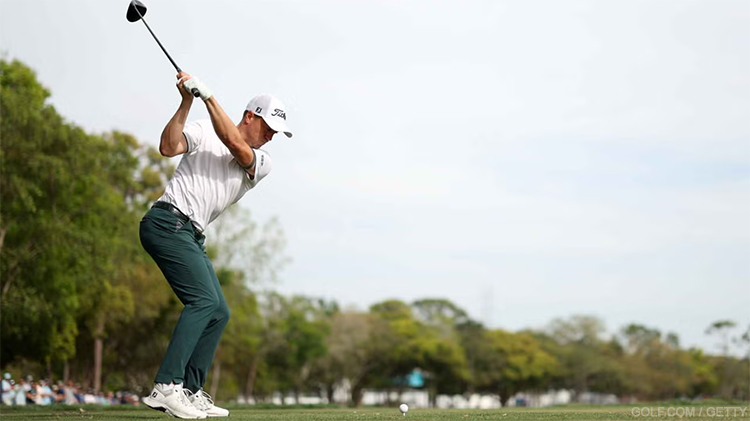
As Thomas gets to the top of the backswing, you’ll notice that his hands are quite high, which is a position that helps in his acceleration during the downswing. His swing coach and father, Mike, told GOLF.com several years back that this position has a few key benefits for his son’s swing. 1. The position creates a feeling of less restriction and more freedom leading to better swing rhythm. 2. High hands allow more time for the clubhead to accelerate in the downswing creating more speed and likely more success with longer irons and clubs. And 3. High hands can create a steeper an angle of attack making it easier to play out of the rough and bad lies.
View this post on Instagram
Article originally appeared on: Golf.com