

Raise your hand if you’re a golfer who at one time has made a New Year’s Resolution to become more familiar with The Rules of Golf? (Stops typing and puts hand in air.)
Now, raise your hand if you actually made good on that resolution? (Continues typing, pretending he didn’t hear the question.)
Mind you, falling short of that goal isn’t necessarily a “you” problem, but often a rules problem. Even after golf’s governing bodies worked to simplify the rules in 2019, it’s hard to get a handle on every last one of the primary 25, not to mention the thousands of clarifications, definitions and decisions.
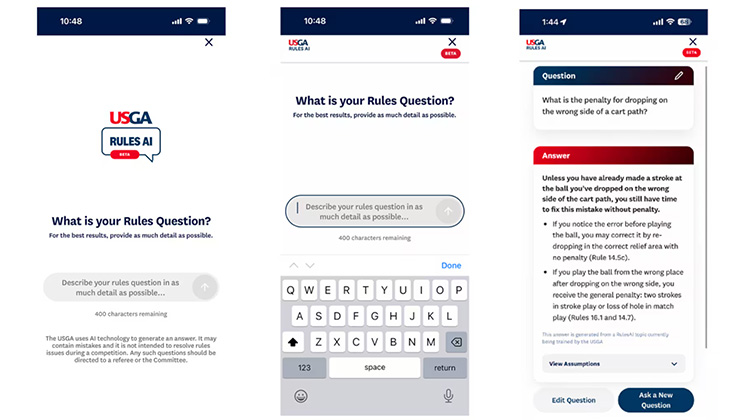
Enter the USGA. On Wednesday, the association announced the launch of a proprietary Rules AI platform that aims to “make the rules more accessible and understandable for golfers everywhere.” Living inside the GHIN app, users will have the ability to ask specific rules questions and get answers for practical application on the course.

The Rules AI platform is currently in a pilot phase with roughly 13,000 golfers having access to the technology after being rolled out through selected clubs around the country. According to Anthony Santora, managing director of IT at the USGA, the plan is to increase that number each month, scaling toward 1 million users by the end of 2026. (Ahead of the U.S. Open at Shinnecock Hills, the plan is to add on roughly 80,000 golfers from the Metropolitan Golf Association.) This will allow them to gather real-world insights and QA data before launching it to the public at large next spring.
Granted artificial intelligence might be the only thing scarier these days than the Rules of Golf. But in many ways, it offers a practical marriage of technology with an organization in search of a way to quickly and correctly distill information that the USGA already has been leveraging for more than 130 years.
Craig Winter, the USGA’s director of Rules of Golf and amateur status, said the idea for the platform began the day ChatGBT became publicly available in late 2022. Along with some friends, he began asking rules questions and saw how fast—and relatively accurate—the responses were. At the same time, there was plenty of bad information also provided, causing him to wonder if the USGA could create its own version with its proprietary info that could be even more helpful.
Santora and Winter say accuracy is the driving force behind the project, understanding the biggest issue with AI to date is its proclivity to provide wrong or outdated information. (Santora described that as “non-negotiable.”) It wasn’t until November 2025—more than two years into the development process—that the USGA team felt confident that, working with Deloitte to create the system architecture, it could build a platform that wouldn’t fall into the same trap.
Unlike other AI platforms fueled by a large language model (LLM), the USGA has fed only the full rules book and decisions book along with roughly 35,000 questions asked by golfers over the year to the USGA Rules Department. (Indeed, for decades the USGA has been doing variations of just this, fielding letters, emails, phone calls asking for rules clarifications.)

By limiting what the AI platform is pulling from to up-to-date, verified content, the USGA is working toward confidently creating a system that provides correct information.
“The goal is to give answers that are as good or better than what we have been giving out,” Winter says.
That mission is so critical that the platform will ultimately acknowledge when it cannot produce a correct answer, referring users to call or email the USGA Rules Department for more assistance.
The goal, of course, is to reduce the number of instances where this happens once it’s launched to the general public. This is being efforted by the creation of multiple computing agents working in specific rules areas that then cross reference and learn from each other to improve their efficiency. Meanwhile, humans are still involved, with the six-member USGA Rules staff (among others) checking the responses that the technology is produced to make sure it has the precision the USGA prides itself on.

The practical applications for the USGA Rules AI platform seem far reaching. In a casual round, when a question arises, the hope is to provide the ability to provide an answer quickly to keep things moving but allow players to feel confident they are adhering to the rules when confronted with a tricky rules situation.
In tournament play, according to Winter, the platform can be a resource for a golf committee to help weed through tough rules issues as well.
“What’s the typical golf committee at a club? It’s normally the pro. That’s who does all of this. And that’s a lot to put on them,” Winter says. “They have a lot to do other than the Rules of Golf they need to be focusing on. And they do a great job with so many different things, but there are so many weird nuances with the rules, and the game is played outside. There’s a lot of different unique situations. So when these questions come to them, I think there are going to be some pros who say ‘Hey, we have the system right there. You can ask the question.’ It’s set up for their golfers.”
As is the case in many industries integrating AI, the fear that the technology will take the place of people making decisions is something that the USGA has acknowledged.
“We’re just trying to get correct information into the hands of those making the decisions,” Winter says. “It’s not meant to supersede a committee’s decision. But we do believe when this gets to a point when it’s mature … that it is OK for committees to check and they’re getting answers as good or better than we can provide.”
As part of the phased rollout, members of Allied Golf Associations will continue gaining access to the Rules AI platform in the GHIN app throughout the coming months. As part of a larger roadmap, the USGA intends to expand Rules AI access to other third-party golf apps in the future.
For now, the platform is not a chat bot that offers a conversational aspect to sorting through the rules, but rather it’s meant for asking specific questions. But Santora says this is a function that the USGA team will explore for the future. So will the possibility of have answers that include pictures and videos.
“We’ll want to see about user engagement and get their feedback to really determine our next steps,” he says.
For now, the goal is “simple” says Winter: “We want a golfer with a phone in their hand not to have to email us and wait or call us and maybe get voice mail, maybe catch us on the line. Maybe it’s after hours. We want them to be able to get these answer in real time as if it’s just like speaking to us.”
Article originally appeared on: GolfDigest.com