

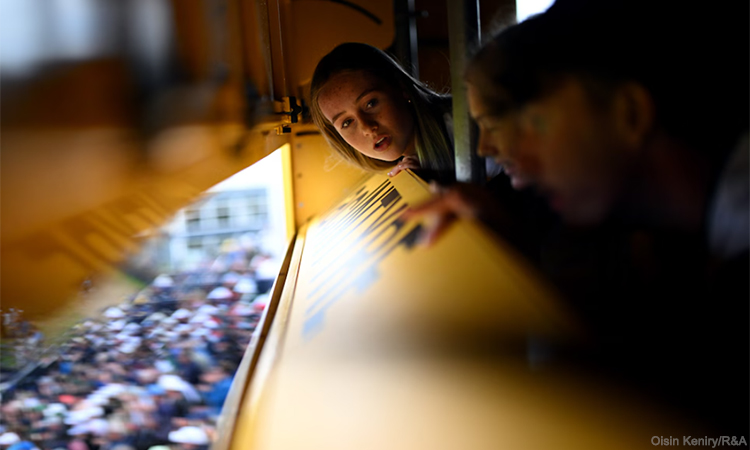
What happens inside the giant scoreboard on the 18th hole that is operated by … teenagers!
A head girl named Gracie wears a headset—over here, “head girl” means something like “class president”—and the information travels the airwaves from Score Control, a hub near the media center. Not long after the new scores crackle in her ear, Gracie and her fellow students from Coleraine Grammar School and Dominican College spring into action, picking up plastic tiles with letters and numbers and sometimes full names from nearby shelves, and placing them backwards—to their eyes—in the giant structure in front of them. Diffuse light comes through that giant yellow wall, but aside from a few cracks, they can’t see much on the other side.
The giant yellow scoreboards at The Open have become an iconic part of the championship.
But have you ever wondered what goes on inside them? The answer may surprise you. 👀 pic.twitter.com/uyKVaBKyai
— Golf Digest (@GolfDigest) July 20, 2025
But everyone can see them … or last the result of their work. They’re the nerve center of a 50-year-old tradition here at the Open Championship that continued this week for the 153rd edition of golf’s oldest major. These are the iconic yellow scoreboards perched above the grandstands on the 18th green, and Gracie’s teen-aged gang are inside them, surrounded by wooden planks and scaffolding and a stairway spanning the three floors of the board. (One thing here—you better learn to duck if you don’t want a bump or three on the top of your skull.) It’s their job to make sure the fans outside, and the TV cameras, and everyone walking the course in the nearby vicinity, are up to date on the drama of the championship.
The twin yellow giants have become a charming icon of this tournament since they were first implemented in the early ’70s, and because they’re so instantly recognizable they transport you to a specific place, not unlike the white-and-green manual boards used at Augusta National for the Masters. It’s true that the boards themselves, and all the students and advisors within them, could be replaced by something digital, and apparently there was recent discussion along those lines, but the R&A fortunately recognized that there’s something irreplaceable and delightful about the analog structures on the final hole.
The recruitment and training of these students, who volunteer their time, is part of a wider R&A program called Careers in Golf, in which people like Emma Robson, a Human Resources Advisor, visits schools to preach the merits of jobs inside the sport that don’t involve actually playing golf. A larger group of students were able to visit Royal Portrush on Monday and Tuesday to get an inside view of the larger superstructure supporting an event of this magnitude—clubhouse, medical facilities, tour trucks, etc.—and a few of those went on to volunteer.

Christian Petersen
At the scoreboard, the jobs involve four-hour shifts, with around eight students manning each of the two active floors inside. The top six players in the tournament occupy wide vertical slots that are changed in and out on the top floor, and the bottom floor, where Gracie called the shots, featured players seven through 12, along with the next six players who would be coming to the 18th hole—their names, helpfully, were on full placards, rather than constructed letter by letter like the leaders. Even early on Saturday morning, when the stands were mostly empty and the players were hours from making it to the last, the scoreboards advertised the day’s best ongoing rounds.
Remarkably, the students only receive a few hours of training. That happens on Tuesday, when teachers from the Cranleigh School in England, who have been doing this for 30 years, give hands-on instruction to the students, schooling them in the finer points of quick, accurate reporting.
Article originally appeared on: GolfDigest.com