

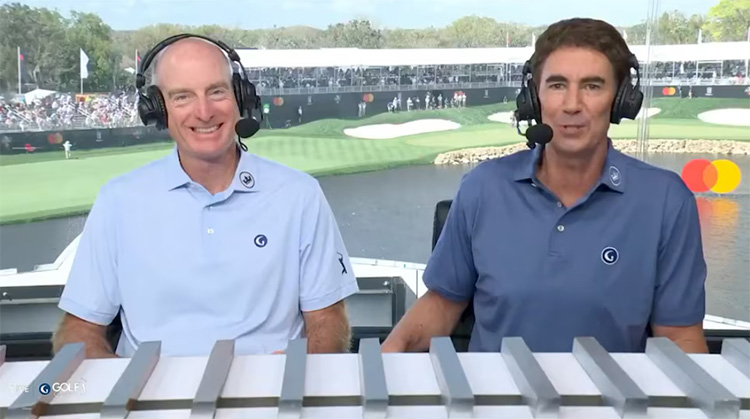
Jim Furyk is learning on the job as he breaks into a second career as a TV analyst
Arguably the most intriguing development in televised golf this year is the emergence of Jim Furyk as a Golf Channel analyst. This second career is still in its infancy; he debuted at the Arnold Palmer Invitational in March, and the U.S. Open will be only his third tournament in the booth, along with a stint of studio work at the Masters. Yet early returns are positive, with both sides seeming committed to extending the relationship.
Golf Digest met Furyk Wednesday morning at the NBC compound at Shinnecock Hills. Furyk nursed a coffee as they sat in a golf cart in the shade, talking about how the 56-year-old made the move to TV, the challenges and rewards, and how it dovetails with another of his “side hustles”—2027 U.S. Ryder Cup captain.
The interview that follows has been edited for length and clarity.
Golf Digest: Anytime I see a player like you move on to TV, I always wondr if is this something you thought about 20 years ago, as in, “yeah, I would like to do TV after I’m done playing,” or is it a more recent idea?
Furyk: More recent. I think 20 years ago, I was in a totally different place in life, right? I had two young kids. The one thing about my job that I probably struggled with was the travel and being away from home. You’re always gonna have that guilt. And so the thought of doing TV at that time would’ve been like, well, I’d still have to travel the same amount. You don’t just pop in for two days and out. You gotta prepare, get ready, do your work. And so looking at that, I was like, “Well, I’d much prefer to play than I would to do TV.”
But, eventually, you know, I have some injuries, and that makes golf harder. My youngest graduated from college, so I started thinking about it last fall and started making some connections. I talked to the Golf Channel, and they were interested, and they’re like, “Well, let’s, let’s try it out.”
How do you think it’s gone so far?
I love the folks I work with. The crew, whether it’s Terry Gannon, Steve Sands, this week will be Rich Lerner for the first time. Curt Byrum. Really everyone’s been friendly. Half of them played, and half of them have been around my whole career, so I’ve enjoyed it. And I like the challenge.
Trey Wingo asked me the best question before API, “How are you preparing?” And I was like, “I gotta be dead honest with you, I don’t know how to prepare.” So I prepared how I would as a player. I want to learn the golf course, I want to figure out hole locations. I want to be able to communicate that to the viewer and teach them more about the course and the shots these guys are hitting.
Once I got in there, I was there for 10 minutes, and all these notes and stuff I had in front of me, I knew it was worthless. I had a yardage book in front of me, I took that, threw it behind me. I got better at it every day, but Day 2, I was five times better prepared to go in there and and talk. Iit’s the same thing as going to tour school for the first time.I didn’t know what to expect, wasn’t prepared.
So what is the preparation that actually helps you?
I had to realize how fast it moves. [NBC producer) Tommy Roy’s whole idea of the production is he wants to show as many shots as possible, which as an analyst and the host, it gives you a very short amount of time to get in, get out, but also give some valuable information. And so I had to learn how to create notes and think ahead to situations that could happen.
When you think of the rhythms of your life as a golfer, traveling a lot, being in these high adrenaline situations, it feels like this duplicates that in a way. Does it feel natural?
One, I think I’ve always had a good relationship with the media. Two, I think I’ve had a pretty good relationship with the fans. And so just being able to hop in and stay close to the guys and what I did for a living, and actually just talk about it…I think I was really good in my career of breaking down a golf course. Figuring out the best way for me to play it. I think that’s what I’m trying to do, is display that for the viewer, to give them a little inside look, at here’s how these guys are breaking down the golf course. Here’s the shot that’s probably intended.
How does your role now as 2027 U.S. Ryder Cup captain impact things?
Someone from the media sais to me, “Well, you’re a captain. I feel like you can be critical.” And I go, “I’m not really sure that’s my job.” I mean, I can say it’s a bad shot, no one’s gonna care about that. But my job is really to teach the viewer something they can’t see or feel on the screen that enhances what they’re seeing.
But I was interested in TV even before the Ryder Cup. Now it’s a little like the cherry on top. I get to come out here, walk the course, I’m seeing the guys on the team. It’s the whipped cream right on top of the sundae.
When you were playing, let’s say you had a week off, were you watching golf on TV?
I am now. But I didn’t used to a lot. I have a new appreciation for the production side of it.
So last fall, you reach out, do they have you doing screen tests? Or is Bay Hill literally the first time you’re on camera, and they go, “gee, we hope he’s decent.”?
All we did was I talked to Tommy for about 45 minutes. Tommy and I are members of the same club down in Jacksonville, but we just talked on the phone. He gave me some ideas, tips, what he likes to see, some expectations. But as far as practice runs, there was none of that. It was really kind of a ‘throw you in the deep end and see if you can swim’ type deal.
That surprises me, because the risk seems so high if you fail.
They told me some stories about times where things didn’t go well, or why things might not go well. But everyone there knows this is your first time, you’re a rookie. So there’s a lot of folks that really, still to this day, reach out and try to help. Tommy would also pull me in usually every morning, and I knew a couple times what he’d say. Where maybe I stepped on someone, or I knew, “I could have done this better,” or he’ll say, “Hey, when you’re leading into the show, I need you to look in the camera more instead of looking down.” One of my habits is I’ll look down when I’m thinking. I don’t know why the answers are in my shoes, but they are.
My wife Tabitha even gave me some of the same notes. She gave me one thing, and then Tommy gave it the next day, and I said, “oh, Tabitha said the same thing.” But a lot of it is, “here’s what I really liked,” and “here’s what we can tighten up and fix.”
Were you nervous at API, and was it at all similar to the nerves you felt before a tournament?
No, it was more like you walk up in the booth, you sit down, you probably get there 45 minutes early. You’re kind of prepping, trying to figure things out, your notes, how you want to lay everything out, and then about five minutes before the gun goes off, then yes, you’re nervous.
Then we went on air, and after the first 5 or 10 minutes, Tommy came on and called commercial, and he goes, “How was it?” And I go, “Really fast.” I was shocked at how quick you had to hop in, hop out and be on the ball. And I needed that commercial just to collect, reset, and go, “all right. I can do this.” It was like I needed the coach to call a timeout, and that was the commercial.
I had a couple questions. One thing we didn’t talk about had to do with the folks on the ground walking with the groups. And I didn’t understand the cadence of Terry, them, me. Sometimes there’d be silence, so I was just like, “OK, I’m supposed to talk, because no one else is.” But no one told me how I know if it’s them or me until the first commercial, so it was like, “I’ll just guess on this one.”
This is the most fascinating part of this for me, because in my head I’m thinking, “you’re going live on air. I would’ve assumed that there’s some practice or something. But it obviously works.
My guess is they like to throw you in and just see how you handle it, and if you can handle it, you’re good.
A little trial by fire?
Yeah, because it’s live, and that’s what you do every damn day. You have to react.
And at that time, Bones was on the ground, Roger was on the ground, Smylie was on the ground. And so I know them all pretty well, and I like to pick their brain. I love having a conversation with them on the ground. They see things I can’t see in the booth.
And that’s on air?
Yeah. Tommy likes that. Dialogue is great. It’s his show, and he kind of wants it to feel like we’re there having a conversation about golf like we would be if we were sitting in the production trailer, but you get to listen at home.
Have you had a moment where you felt like, “I did something really well there, I’m starting to get this”?
There’s been stuff that’s fun for me. I like knowing some of the guys’ games. So at Bay Hill, they’re playing 18, and the wind is whipping right to left off that tee. Everyone is trying to hit that low stinger cut up the right side. And I have Chris Kirk playing pretty well, and I know Chris hits a high draw, and he hits it a lot. He doesn’t really change. So I had time to set up the shot. And so I said, “All right, what I’m really interested in is, we see a lot of those guys aiming up the right side, trying to hit that low cut, keep it in this fairway,” because everything wants to roll left on the ground, the wind’s pushing it that way. I go, “That’s not Chris’s game. Chris likes to hit a high draw. I’m really curious. Pressure situation. Is he going to just aim it out there way right and let it ride the wind, or is he going to go off what would usually be his normal game and try to hit a low cut and hold it?”
And that’s about the time he put the tee in the ground and set up, and you can see on camera, and I go, “That answers our question. He’s hitting a big draw.”
That’s something my buddies at home, they’d have no idea, they wouldn’t even think about it. And he hit the big draw that started out over the trees, and it landed a yard in the right rough. And that was just based on knowing his game.
You mentioned before that your relationship with the media has always been good. I’ve seen you react to questions after tough moments in a calmer way than many other golfers. Where does that come from?
I’d usually hovered in the scoring trailer for a few minutes, try to decompress. Try to calm down so I didn’t bite someone’s head off. And trust me, I did sometimes, because now working on this side, two or three guys have had fun. Rex Hoggard said it on-air one day, we were talking about Scottie, and Rex was like, “You know, I remember interviewing Jim Furyk and I asked a question. He wasn’t too fond of it.” And I’m sitting in there with everyone in production and everyone’s laughing. And then another guy goes, “Oh yeah, you did that to me here.” And then I go, “Jesus, I’m catching strays over here. I’m just doing my work.”
But a couple times, I actually walked back to the media room and apologized to a couple guys and said, “You know what? I was in a bad mood. I wasn’t happy with the way I played.” I go, “It was a good question, I just didn’t handle it right.” And then I actually have had a couple guys come up to me and say, “You know what? I was out of line there.”
I feel like there’s always been a give and take. You know, we’re human, we’re not perfect.
Going back to TV, do you check feedback?
I haven’t listened to myself. I haven’t gone back and watched myself on tape. I think it’s because we get done and it’s over. I was really surprised, the first day I was on air for three or four hours, and when the camera lens went off, everyone left the building in like 60 seconds. It was a ghost town. And I’m still packing my bag.
But Tommy’s the boss. He’s the producer, he’s the head dog. You get a lot of pointers here and there, but at the end of the day, if he gives you a couple things to work on or to think about or to get better at, that’s your goal.
I think the goal in golf, even if you’re Scottie or Rory or Tiger, they’re always trying to find little ways to improve and get better. And this is my third event of live golf, surely there’s a lot of improvement that can be made, and so it’s a big learning curve and process. And I’m kind of trying to soak it all up and, and do the best job I can.
Can you see yourself doing this for 10, 15 years?
I wouldn’t put a time limit on it, but we’re definitely working on it. We’re definitely working on the next few years, for sure.
One last thing—what’s the adrenaline on TV like? How does it compare to playing days once you’re on the air?
There’s definitely a rush, but it’s not like having a third-round lead at the U.S. Open. I haven’t had trouble eating breakfast, put it that way.
Article originally appeared on: GolfDigest.com